I'm thrilled to announce that I have a project included in the soon-to-be-available new book, Metal Clay & Color, compiled by Mary Wohlgemuth and published by Kalmbach. The project is a step-by-step tutorial to making a fine silver clay ring with an embedded band, accented with a jolt of colored resin. I give tips on how to mix color into the resin, how to level the resin in the reservoir, and how to avoid bubbles as the resin sets up.
Wednesday, May 30, 2012
Metal Clay & Color
Monday, May 28, 2012
Combining Argentium with Fine Silver Clay
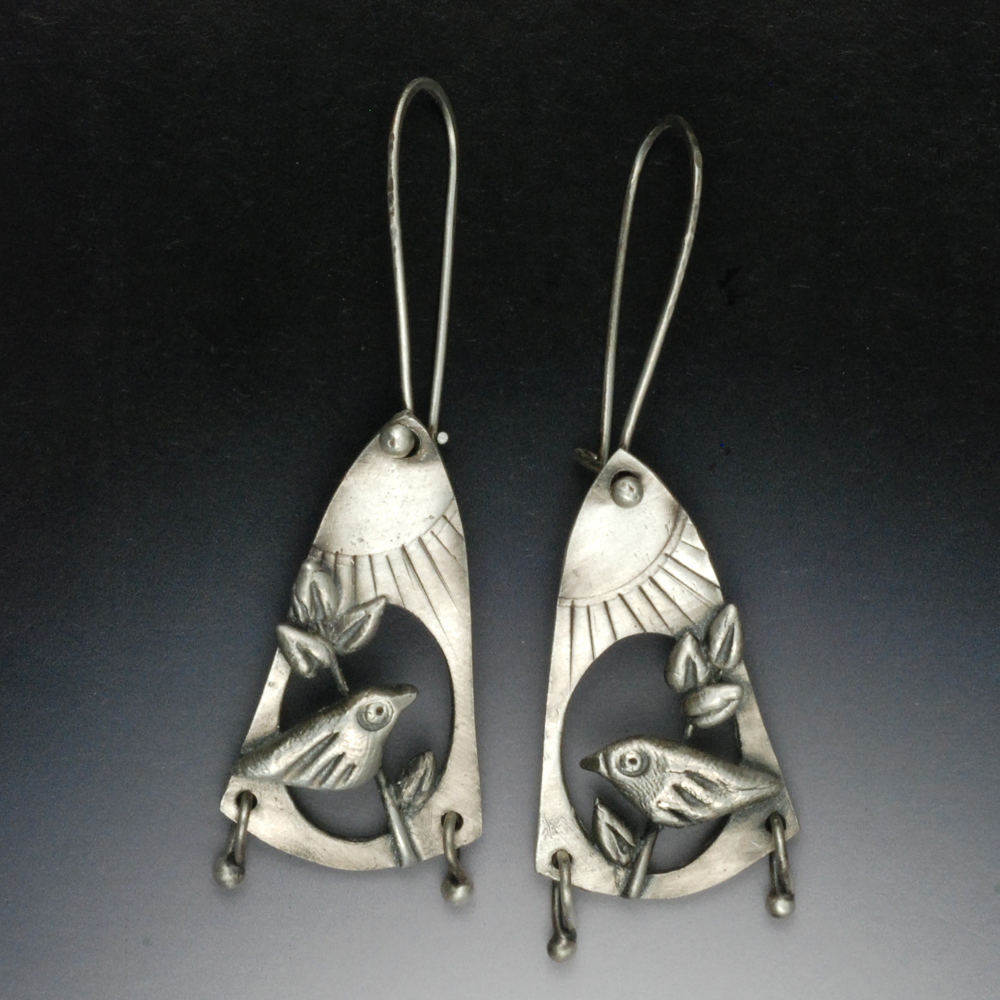
After four weeks of class and my initial ring test, of course I have a zillion ideas for projects combining Argentium with fine silver clay. At the end of the the earring course, I started work on making an adaptation of my Meadowlark earrings in Argentium.
![]() |
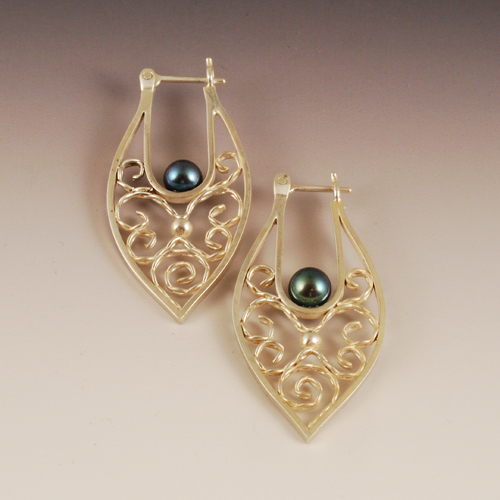
| ©2012 Vickie Hallmark Goldberry earrings Argentium sterling silver, fine silver, 18K gold, peridots fused, no solder |
![]() |
| ©2010 Vickie Hallmark Meadowlark earrings fine silver with Argentium wires metal clay |
Sunday, May 27, 2012
Another Jewelry School Project
I left out one of the week's projects, perhaps the most detailed. We formed this bead-bar hook-&-eye clasp from large jump rings for the bars, with added small jump rings and granulation for decoration and reinforcement. From this project I learned the pros and cons of fusing and soldering. Too much heat causes the Argentium to roughen. On such an intricate piece, the roughness is impossible to completely sand and polish out. Soldering requires much less heat, so avoids the roughening issue. My tendency is to want to fuse everything and avoid soldering, but I finally realize that I must embrace both.
![]() |
| Argentium bead-bar hook-&-eye clasp |
Saturday, May 26, 2012
Jewelry School Adventures - Chains & Clasps
The topic of this week's class was simple clasps and chain. First we learned to make jump rings in various ways, including sawing wire coils and using a jump ring maker. We fused a batch of the smaller rings and squashed them gently into ovals. Then we assembled the chain with heavier round links that were soldered. We added a heavy ring and toggle bar with ball ends, both with soldered jump rings.
![]() |
| Argentium chain link bracelet double oval fused links alternating with single round soldered links |
Afterwards, we moved on to forming wire into a simple S clasp and pendant enhancer, both in heavy 14 gauge wire which made them more difficult to form than my usual lighter weight experience. I particularly enjoyed the interlocking C ring clasp, which was actually quick and easy to make once you know the trick.
![]() |
| Argentium S hook, pendant enhancer & interlocking C-ring clasp |
![]() |
| drawn Argentium tubing |
![]() |
| Argentium bayonet clasp made from drawn tubing and split wire |
Thursday, May 24, 2012
Argentium Silver vs. Sterling
Argentium IS sterling silver. It actually has more fine silver than conventional sterling, 935 vs 925 parts out of 1000. But whereas conventional sterling has 75 parts copper, Argentium has 55 parts copper and 10 parts germanium. That little bit of germanium changes everything. As of today, one ounce of sterling wire is priced at $32.25, whereas Argentium is $34.90, or about 8% higher.
While there are now many new alloys hitting the markets, patented Argentium is unique because of its germanium content. Germanium loves oxygen even more than copper does, so it will travel to the surface where it scavenges oxygen to make a clear germanium oxide layer and exclude black copper oxides -- NO fire scale! The lack of fire scale means no aggressive and toxic pickles are needed to remove the copper oxides from the surface. Mild citric acid, vinegar with salt, or even simple boiling water are quite sufficient to remove the remains of flux. After years of atmospheric exposure, Argentium develops only a mild golden patina.
Germanium also changes many other properties of the alloy relative to conventional sterling. Argentium is brittle when hot, so traditional jewelers may be off put by their first interactions with this new material. Touch the hot metal with a tool and it will crack or even shatter. Quenching is also to be avoided, since the metal is so brittle when hot. Simply air cooling for a few seconds longer, or placing on a metal block to suck the heat out faster, will avoid this frustrating issue. No more than a mild sizzle when hitting the water should ever be heard.
I started using Argentium silver several years ago because it forms beautiful balls for wire attachments in my jewelry, as compared to sterling which gives pitted, deformed balls. At least two years ago, after reading that Argentium could be fused like fine silver, I experimented successfully with fusing the two together. Since that point, I've been wanting to push the idea further and combine metal clay with fabricated sheet and wire components in my work. With metal clay almost four times the price of wire or sheet, it makes sense to only use metal clay for elements where its properties give it a huge advantage over conventional techniques, principally sculptural work that could only be done traditionally via time-consuming wax carving followed by casting. In that situation, metal clay really excels.
The videos above are from Ronda Coryell's four volume DVD series about Argentium, available from Ronda's website.
Saturday, May 19, 2012
Jewelry School Adventures - Earrings
The final project of the Earrings class involved filagree and making tiny mechanisms. First we flattened square wire into rectangular wire, then cut, formed and fused it into the perimeter of the earrings. Then we twisted and flattened the filagree wire to cut & form into the delicate pattern. Once that was all wedged into place with just the right amount of tension, we fused it all in place. My slightly different design included the silver balls which were placed after the wires were secure.
![]() |
| argentium fused filagree earrings with soldered mechanism from sheet & wire |
The earring mechanism was the tricky part. We formed sheet and wire into the tiny riveted post and spring
clasp, both soldered onto the top of the earrings. Finally, we glued pearls onto a soldered post in the center.
Wednesday, May 16, 2012
Jewelry School Adventures - Earrings
This week's class is Earrings, Mechanisms & Granulation. We have twice as many students, attesting to the popularity of earrings. On the first day, we made two pair. First up, twisted square wire hoops. Argentium is so malleable that it twists easily and beautifully. If you have an area that didn't twist the same as the rest, you just anneal the part you want to twist more, leaving the rest hardened, then correct the problem. Mine twisted perfectly the first time. The we cut 3/4 rings, melted some large balls and fused them onto one end of the rings. After that, we made tiny jump rings and soldered posts into the jump rings for extra support on the business end of the hoop.
![]() |
| twisted square wire earrings fused & soldered Argentium sterling silver |
![]() |
| fused and slumped earrings Argentium sterling silver |
![]() |
| granulated Argentium sterling silver bezel set onyx |
Tomorrow, we start filagree!
Saturday, May 12, 2012
Jewelry School Adventures - Flush Setting & Sweat Soldering
As the week has progressed, my sawing skills have improved dramatically. The instructor and the three students all had a good laugh at the planning that suggested only three saw blades per person for the week. Even Ronda went through at least a dozen. We started out with 3/0 blades and worked progressively finer as we attempted more complex cuts.
![]() |
| Saw-piercing practice |
Along with sawing, we learned roller printing and flush stone setting. I admit to flunking stone setting on the first day, which just made me more determined to get the hang of it. On the second day, I set the same ten 2mm CZs over and over again. I could still use some practice, as in my final piece, the setting bur took off on me and cut the center hole too deep. I also still sometimes slip with the burnisher and put a scratch into the pre-finished front.
![]() |
| bird brooch sketch |
![]() |
| fused argentium & 22k gold with flush mount CZs |
Then I deviated again, as I felt I'd prefer to practice fusing Argentium rather than sweat soldering. The assignment was to learn to work with thin widths of metal overlay, to fuse on 18K gold granules and to set stones. No solder was used for this construction so far, although I may solder on the pin mechanism.
I can officially say that I got what I came for after two weeks of class. My vision was to make my window pieces out of argentium with the bird & branch made of metal clay fused on top. Can do. Next week's class is Earrings, Mechanisms, and Granulation.
Wednesday, May 09, 2012
Jewelry School Adventures - Sawing
I am continuing with another class at Jewelry Studies International. The topic of the week is Sawing & Setting. While I've got beginner sawing skills, I thought a week of intensive practice would be just the ticket to confidence to tackle any idea I might conceive.
The first day of sawing involved several practice pieces, first in copper and then in brass. We learned to mark patterns by gluing on a paper template, transferring the toner image via acetone, and scribing for precision. We also learned to cut and file edges to make a woven illusion.
Many hours of sawing later, my poor left arm (the holding side) was complaining, but I was improving. A major transition occurred when I reversed the direction that I cut from clockwise to counterclockwise.
On the second day, we graduated to Argentium sterling, which cuts like butter. The tiny piercings in these Celtic knot work earrings are so small that it's almost impossible to file, so the objective was to cut so cleanly with the 6/0 blade that clean up would be unnecessary. Failing that, we used the saw blade itself to file the inside edges. Then we roller printed copper for a background piece, and I went my own direction rather than cut the plain triangular pieces. I now understand why I should buy highest quality saw blades by the gross!
Tuesday, May 08, 2012
Affirmation 6 - Help
The affirmation book is continuing. For the hummingbird, I thought my usual tree background didn't fit well enough, so I experimented with a new salvia background. I'm loving it and thinking about how to incorporate it into other work somehow. This is how different media play off one another for me. The garden tells me salvia for hummers; I experiment with drawing it; then somehow it will make its way into glass or metal.
Sunday, May 06, 2012
Stock Tank Pond Update
After many weeks of green, the stock tank pond finally cleared. One day I could suddenly see a few inches down, then the next day further, and after about three days I could see the bottom. It was a relief to verify that all five goldfish are alive and well.
![]() |
| stock tank pond |
![]() |
| Colorado water lily |
![]() |
| Wanvisa water lily |
![]() |
| blue bottle tree |
![]() |
| new stock tank pond garden |
Saturday, May 05, 2012
Jewelry School Adventures - Fancy Rings
After finishing up one week at Jewelry Studies International, my head is spinning with ideas. On the fourth day, we finished up the flared ring and started another. Although I originally sized my outer ring so that it was free to spin, I decided that I really didn't like it (perhaps it moved too much). So I stretched the flared band out enough to tighten against the outer ring and lock it into place, which was the original design anyway (did you know that spinner rings are patented?). The protected part of the flared band has a deep black patina, while the edge, outer ring, and inside all have a bright, burnished polish.
![]() |
| flared capture ring and band with fused jump rings and granulations |
The final project of the rings class was a complex fused jump ring and granulation project, which required more finesse than I yet have to get the rings all perfectly shaped and spaced.
![]() |
| granulation ring |
![]() |
| file silver clay bird fused to Argentium ring shank |
Wednesday, May 02, 2012
Jewelry School Adventures - Simple Rings
I've embarked on a grand adventure: attending classes at Jewelry Studies International. This new teaching studio in Austin offers two Jewelry Arts Diplomas designed exclusively around Argentium silver. The relatively new alloy adds a small percentage of germanium to the silver and copper mix, changing how absolutely everything works. No more fire scale, very slow tarnishing, and the ability to fuse as well as solder open up lots of possibilities for this new material.
![]() |
| first fused rings in Argentium sterling |
![]() |
| fused Argentium sterling rings |
![]() |
| Ancient Bronze Bracelets, with ancient bronze, 22K gold, granulation and diamonds by Ronda Coryell |